Monique Lacey
“In this time of flux and turbulence our ability to make sense of the world seems to have been obliterated. I listen to US political ongoings via CNN in the studio. Donald Trump’s slurred speech and ability to skew a soundbite into a completely new language, is beginning to have a major impact on our culture. This leaves us focussing on memes and not the message. My work speaks to the nature of these circumstances.
Starting with commercial packaging materials purchased at local hardware store, my work seeks out structural propositions through volume and surface. Materials are assembled and covered with plaster, pigments, wax. While there is an adherence to truth of materials, the materials are used to construct a level of artifice in the work. The transformation and elevation of the ordinariness of the humble, cardboard box fascinates me. Each form is countered by a crushing act that results in a substantial reconfiguration. Performative motion, playful, aggressive and cathartic.
My work finds it footing in Minimalism, the largely male dominated era, where we found the likes of Donald Judd making anonymous “specific objects”. So being invited to participate in the Mother Mother Project which was initiated by a woman for women was an immediate antidote to that notion. The idea of a non-hierarchical revolving exhibition where each artist nominates another (female) artist was something I connected with. The way the project is run allows for unexpected outcomes by combining artists that are nominated independently. This opens up possibilities for future collaborations that I might otherwise not have considered. My nomination for the project was Rose Meyer, who also uses cardboard boxes as a starting point for her work, so I was interested in seeing what she would do.”
Monique Lacey x mothermother 2020
All That Glitters: Monique Lacey’s Truth-y Minimalism
Inga Fillary
In 2013, comedian Bill Maher suggested Donald Trump was the son of an orangutan. Around the same time, I came across a meme showing an ambiguous tress of hair captioned, “Is it Trump or is it an orangutan?” The joke, of course, was that the distinction no longer mattered.
The then-newly minted term post-truth was Oxford Dictionary’s 2016 Word of the Year, describing a world in which “objective facts are less influential in shaping political opinion than appeals to emotion and personal belief.” Nearly a decade later, post-truth has shifted from descriptor to operating system, a chronically acceptable political strategy. In this distorted landscape, factual accuracy is no longer required; being truth-like, or ‘truth-y’, now outperforms concrete fact.¹
It is this ascendant truth-iness, its slipperiness, and absurdity that underpins Monique Lacey’s practice. While her polished, gleaming sculptures initially read as minimalist monoliths, their playful titles immediately puncture the cool sophistication associated with the movement. “Stable Genius”, “Orange Lotus”, “Frontrow Techbro”, and “Plastic Patriot” are all lifted from American news channels. The US political pantomime being played out affects us all, and Lacey is acutely aware of this. Much of her research involves scouring news podcasts and TV shows for political fodder to be distilled and refined. On a visit to her studio, I notice the possible title “Eating the dogs” scrawled on the wall. A nod to the way non-facts circulate freely when they “feel true enough.” To quote J.D. Vance, such claims “capture the spirit and the heart of the situation,” regardless of their relationship to reality. Repeat them often enough, and they harden into emotional fact. It is the reassuring optimism in her subtly humorous approach that is Lacey’s superpower. The ability to laugh in the face of danger somehow makes today’s strange reality more palatable. Unlike a politician, however, Lacey freely admits to the ‘deceptive’ tactics of her creative process. She takes humble, functional cardboard boxes and, with playful, faux-aggression, uses her body to crush and distort their flimsy structures, sometimes lying spreadeagled on the larger works, or performing a CPR-like motion on the smaller ones. She overlays them with various combinations of plaster, resin, rubber, wax and shiny paint. The glittering skins of chromed alloy render the infirm substrates unrecognisable and lend truth-y strength and counterfeit robustness to the sculptures.
In the high gloss of the works, a disfigured me is reflected back at myself, like a fun-house mirror mimicking the skewed socio-political feedback loop of misinformation. The Tate Institution describes minimalism as "a highly purified form of beauty… representing such qualities as truth (because it does not pretend to be anything other than what it is), order, simplicity and harmony.” It is ironic, then, that Lacey’s work, although outwardly sharing characteristics with minimalism, seems to perform almost the exact inverse. Where minimalism seeks truth, Lacey finds post-truth; where it values order, she introduces collapse; where it champions simplicity and harmony, she overlays fakery and strategic chaos. But despite the irreverent titles and laissez-faire attitude toward global politics, the objects retain the solemnity and apparent substance of modernist form. Lacey balances formal inquiry with breezy sarcasm, so the work oscillates between sincerity and send-up. For me, it is the simplicity of the gesture that hits home. Lacey takes flat-packed, disposable materials and renders them priceless. Through repetition, she turns a single action into a method. She repeats and repeats the action, making small modifications, ever refining and gently pushing the process forward to stage her quiet protest against the noise of misinformation.
Postscript Actually, as any primary school child will tell you, an orangutan is a great ape, but “monkey for the masses” feels truth-adjacent enough that the facts hardly matter.
Inga Fillary (2025)
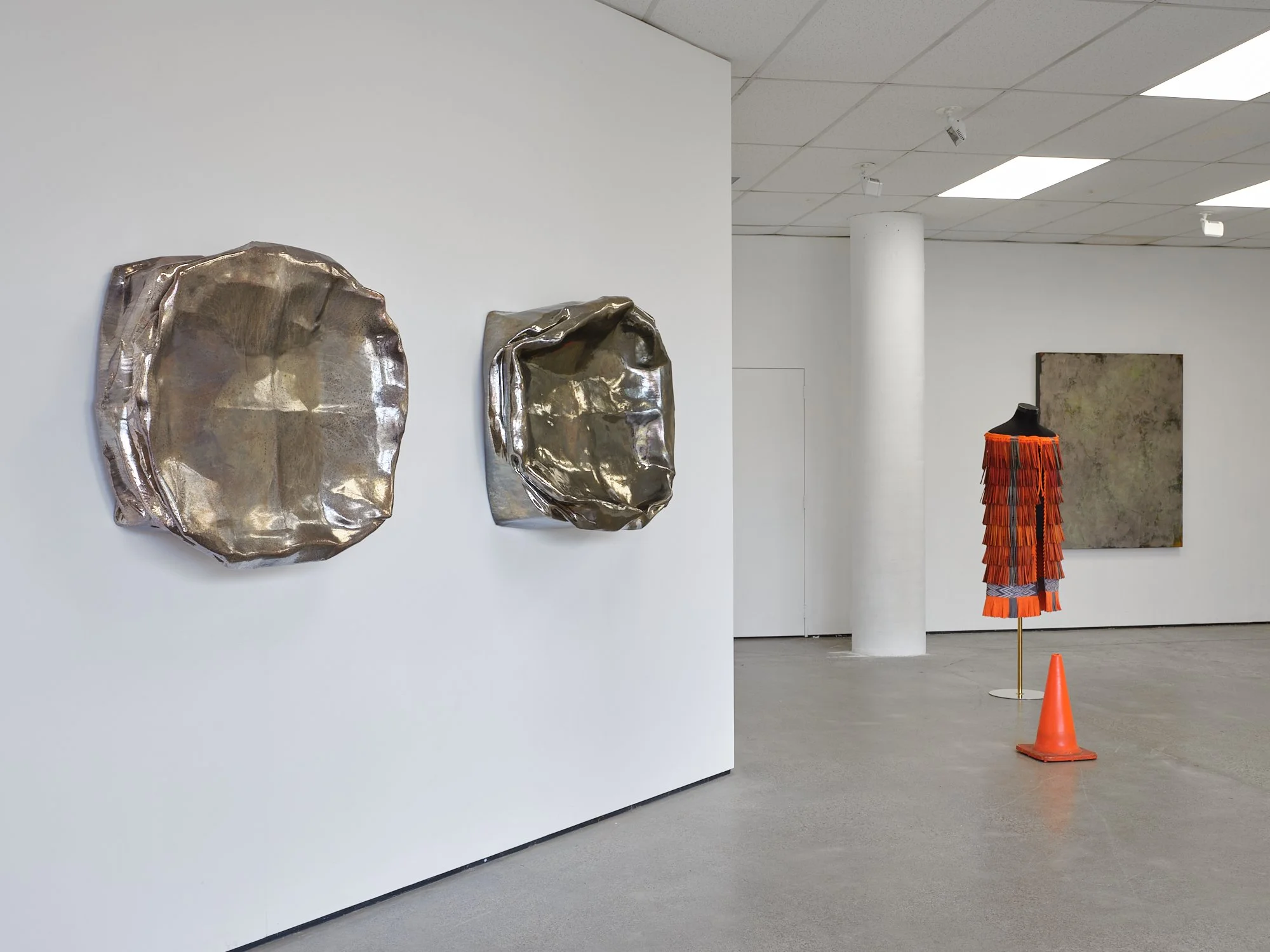

'Puffy', 2019, cardboard, plaster, paint, resin. Image courtesy of the artist

'The Strong and Silent Type', 2019. Cardboard, plaster, paint, resin. 300 x 200mm. Image courtesy of gareth moon

installation view, left to right, with kelly pretty, rebecca wallis, unique lacey, teresa peters and inga fillary, 2019

'Char', 2019, tin, pigment, paint. Image courtesy of the artist

'Turkish delight', 2019, cardboard, plaster, paint, resin. Image courtesy of the artist

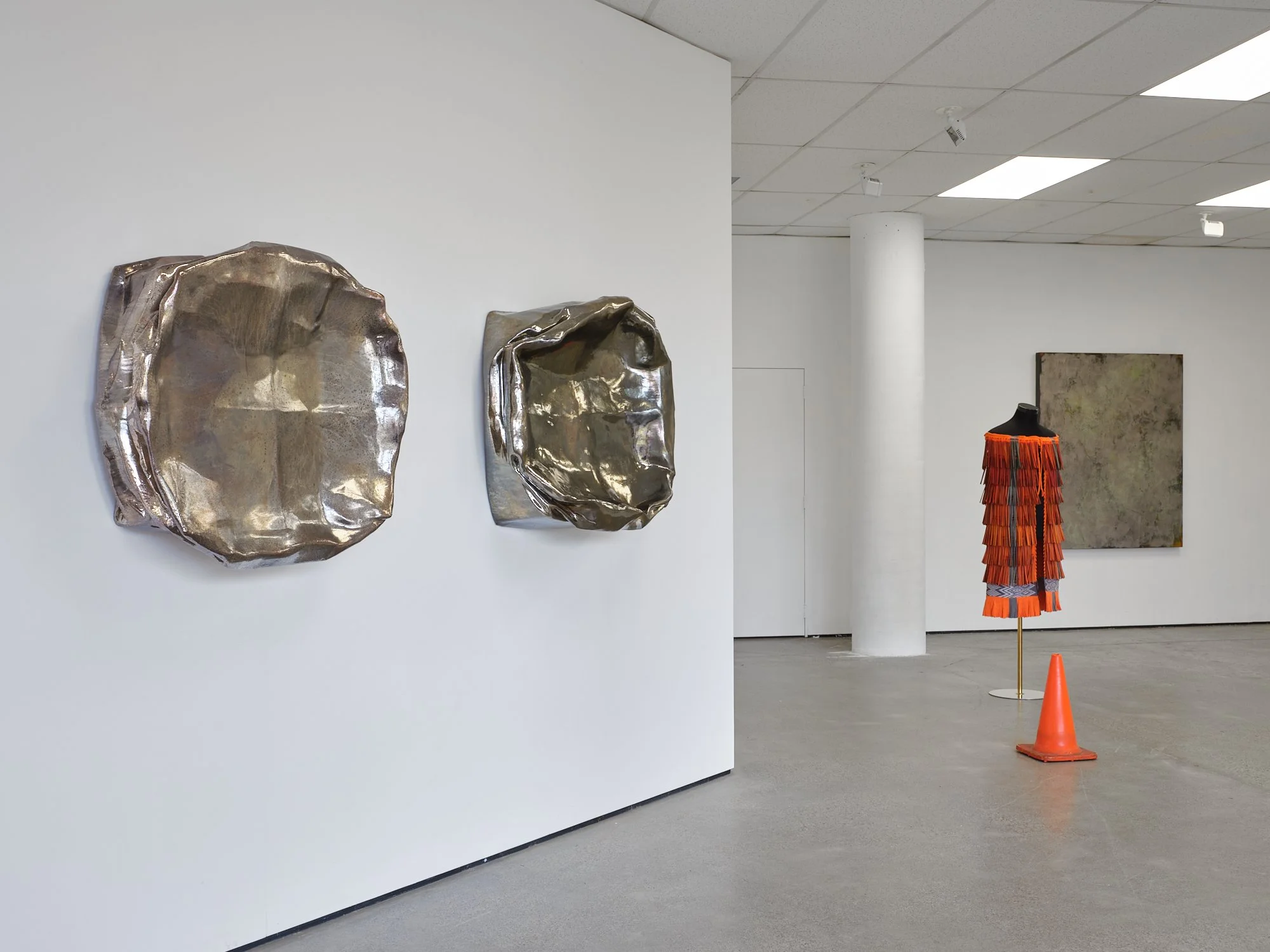
'Flat-packed materials are realised, but while adhering to material truth, the truth is always malleable. The low hierarchy of the humble cardboard box is an invitation for transformation and elevation, a process that is metaphorical for the times we live in. Seeking progress, the assembled form is covered with plaster, paint, resin, rubber, wax, varnish and pigments. Then the act of crushing utilises bodyweight and motion, enacting a playful and aggressive execution that is sometimes cathartic or darkly humorous. The original potential of the materials is rerouted, substantially reconfigured. The times we find ourselves in are strange… precarious.
In the sweet and destructive moment of collapse, distinctions between surface and form, image and object, sculpture and painting are under tension and the male dominated era of Minimalism sharply under critique.
Monique has held recent solo shows in Auckland, Wellington, Houston, and Melbourne. In 2019 she was a finalist in the Molly Morpeth Canaday, Wallace Art and Walker and Hall Awards, and in 2018 completed a first class honours Masters of Fine Arts from Whitecliffe.